The intermediate stage is where surfing really gets fun. You paddle into green waves on your own, ride along the face and start thinking about turns. It is also where many surfers plateau for years. These tips from our coaches will help you keep progressing.
Ride the right board for longer
Staying on a bigger board for longer is the best thing you can do for your progression. Learn to trim, turn and carve on a longboard, then move to a mid-length with more manoeuvrability. Only switch to a high-volume shortboard once you can generate speed and turn on a longer board. Downsizing too early means fewer waves and slower learning. More in how to choose a surfboard.
Look down the line
If you struggle to make fast sections or keep falling off the back of the wave, check your eyes. Your head and shoulders steer the board. As you pop up, turn your head and look along the wave. Your hips follow, and you will stay high on the face where the speed is.
Surf with your whole body to generate speed
Speed comes from moving up and down the face of the wave. After your bottom turn, extend your body and arms up towards the top of the wave, then compress by bending your knees as you come down. Repeat in a smooth rhythm. Small pumps on a long board, bigger ones on a short board.
Master the bottom turn
Every good manoeuvre starts with a good bottom turn. Drop to the bottom of the wave, bend your knees, put weight on your inside rail and look at where you want to go on the face. A solid bottom turn sets up everything else.
Your first manoeuvres
Cutback
A turn back towards the breaking part of the wave when you get too far onto the shoulder.
- Build speed down the line.
- On the open face, shift weight to your back foot and lead the turn with your front hand, then your head and shoulders, then your hips.
- Carve a smooth arc back towards the whitewater.
- Bounce off the foam or re-engage your rail and continue down the line.
Floater
Riding over the top of a section that is about to break in front of you.
- Do a bottom turn and aim at the breaking lip.
- Lift the nose slightly and let your speed carry you across the top.
- Stay centred with knees bent, then come down with the whitewater and keep riding.
Timing is everything: hit the lip just as it starts to break.
Snap
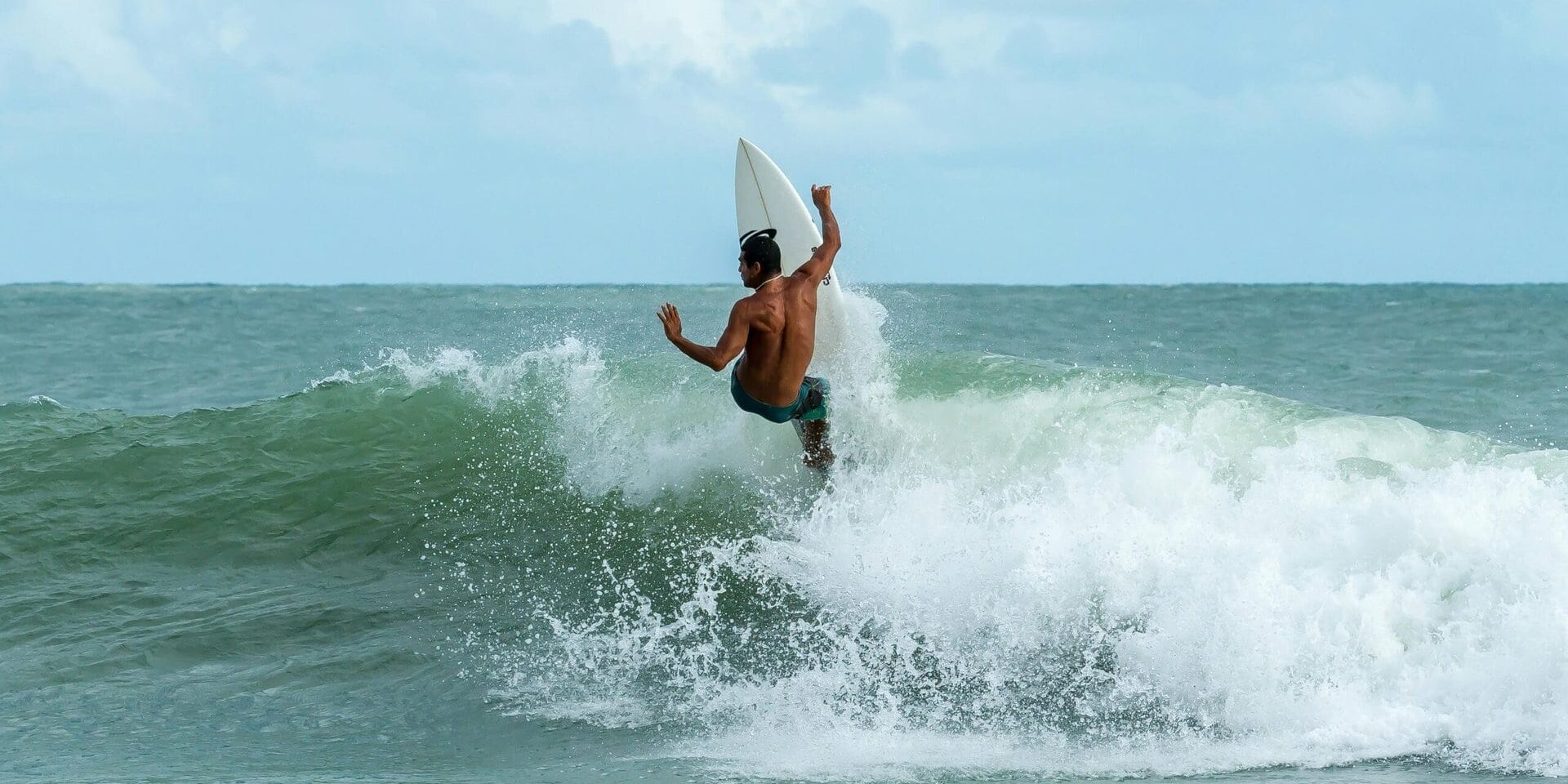
A quick, sharp turn off the top of the wave.
- Build speed and do a strong bottom turn while coiling your upper body.
- As you reach the lip, unwind your shoulders and push the tail around with your back foot.
- Come straight back down with speed.
Surf the right waves at the right time
Intermediate surfers improve fastest on clean, medium-sized waves with soft sections, not on heavy days. In Central America, the dry season (roughly December to April) often brings exactly that, with offshore winds grooming the surf. Learn why in Papagayo winds explained. Sandy beach breaks like Playa Guiones are ideal, and Ayampe in Ecuador offers a friendly beach break with points and reefs nearby when you are ready for more.
Lessons, coaching or guiding?
- Lessons: best if you are rebuilding fundamentals.
- Coaching: best for specific goals like speed, turns or reading waves. Video analysis speeds this up.
- Guiding: best if you surf independently and want more waves at the right spots.
Ready for your next level? Book video surf coaching in Nosara, Playa Venao or Ayampe, or read how to read a surf forecast.